
Click Here for Episode 5
And now the season finale.
With the culprit now identified Hermes and Hekate get help from an unlikely ally for the final confrontation.
Visit the show main page here.

Click Here for Episode 5
And now the season finale.
With the culprit now identified Hermes and Hekate get help from an unlikely ally for the final confrontation.
Visit the show main page here.
 Much like Dark Knight Rises last year, rather than just review of Man of Steel, I want to look at how it represents the characters in relation to their counterparts in both comic books and pop culture in general.
Fair warning, this article is going to have spoilers for Man of Steel, consider yourself warned.
Since Man of Steel is a reboot of the Superman movie franchise, we find ourselves with yet another telling of Superman’s origin.
The first part of the movie I like because it gives one of the best takes on why Krypton is doomed; the planet’s core was drained to provide energy, and lead to the planet imploding. This is of course topical, but also has a feeling of realism, compared to what is normally just a hand wave.
Of course this part also has some downfalls. The first is that amidst the end of the world, the military decides to stage a coup. I know this was done to provide an introduction for Zod and set up him for later, but it just comes off as odd.
You also have a bit with the genetic codex of Krypton. This I am more forgiving of. It harkens back to the post-crisis relaunch of Superman with Krypton being dependent on clone technology, and gives added motivation for Zod to come after Superman. Other than that, it is basically a McGuffin to drive the plot.
As for the characters, it is an interesting mix.
Or course we have to start with Henry Cavills’ performance as Clark. Right off the bat, you’ll notice that I called him Clark instead of Superman on purpose. While they do call him Superman in the film, it is treated initially as a nickname. The character is treated as a man on a journey to find himself and his place in the world. A lot of people complain that he is not the Superman they grew up with, and that is a fair but incomplete take on the character. This is Clark Kent figuring out who he is and where he fits in the world; so no, he is not the Superman you know, at least not yet. If this film is about anything, it is the events that shape Clark into Superman. He already has the instincts to do the right thing, but is not necessarily sure how to go about it.
Amy Adams as Lois Lane is on a completely different front. This is one of the best representations of Lois outside of the comics ever. She is smart, competent, brave, and a bit of a daredevil. There are two factors that put this Lois above the rest. One is that they show her investigating the mysterious figure that is Clark, and she figures out who he is. I think this is a first in any version of Superman, in which Lois knows Clark’s secret even before the public at large knows about him. The benefit is that there is never a need for her to be played as clueless in not being able to figure out that Clark is Superman. She knows from the onset and is an active partner. This leads to the other factor – Lois is as important to the resolution of the story as Clark. She has information he needs in order to defeat the bad guys. Trusting that she knows what she is doing, he never once tells her to go to safety. And of course Adams’s performance is perhaps the best in the entire film.
Michael Shannon as General Zod is another interesting study. I have been a fan of Shannon for a while and was happy to hear he was cast in the movie. I was also happy to hear that he was in no way even going to attempt to copy anything from Terrance Stamp’s performance from Superman II. The role of Zod in the movie is very consistent with his recent portrayal in comics. He is devoted to Krypton above all else, and if he must destroy Earth to recreate Krypton, so be it. I like the inference in the film that this is a result of how Krypton bred and raised children to fill a specific role in their society, and so Zod had no idea how to do anything else, but it could have been done better if this was made clearer earlier as I mentioned with the issues with the prologue.
My biggest issue with the film is the portrayal of Jonathan Kent. I think this is one of Kevin Costner’s better performances in the last few years, but I do not like how he was written. In the comics, it is Jonathan that instills the values into Clark that will lead him to be Superman. The movie tries to say this is what happened, but it is not what they showed us. Every time we see Jonathan mentor Clark, he is more concerned with keeping the secret than he is with doing what is right.
Russell Crowe as Jor-El is pretty straight forward. He is playing Jor-El just as he has been portrayed in the comics since 1985. Honestly, it is a solid performance and does more to move Clark towards Superman than Jonathan does.
For the rest of the performances, they are generally well done, but brief. Laurence Fishburne as Perry White is good casting, because he provides a shorthand to the character, which is needed as there is not much on the page.
Diane Lane gets about the same as Martha Kent. She doesn’t have much to do in the flashback scenes with Costner, and in the present, she is the tough widow who believes in her son and isn’t going to let an alien invasion phase her.
Real quick I want to call back to an earlier article and talk about the character Jenny, played by Rebecca Buller. It is never made clear if she is supposed to be a female version of Jimmy Olsen, or just a Planet staffer who Perry looks out for. Either way the character is too minor for it to make much difference.
So let’s talk about the scene that has all the fans in an uproar. Again, spoilers ahead.
After all the destruction that has been visited on Metropolis by the Kryptonian invaders, after said invasion force has been destroyed, after Superman and Zod have had a battle that has caused untold damage, the final show down occurs.
With Zod threatening to just keep killing humans and actively trying to kill a family, Clark breaks his neck, killing him.
This rubs most fans the wrong way as one of Superman’s big rules is that he does not kill.
Except in the comics he has, and it was Zod he killed.
In 1988 John Byrne wrote a story where Superman faced a Zod from another universe. In his universe, Zod had destroyed Earth, even with our Superman trying to save it. Superman defeats Zod, who then claims he will find a way to the main DC universe and destroy that Earth. Superman believes him and finds the only way to make sure this does not happen is to kill him.
But that is not the end of the story. The next years’ worth of stories are based around Superman struggling with that decision and ultimately declaring that he will always find a better way in the future.
In the movie, immediately after killing Zod, Clark is overcome with grief over having done it, and is comforted by Lois. Clearly this was not a light decision and weighs on him. If we do get a sequel, my hope is the writers build on this just as the comics did.
In the end I did enjoy Man of Steel, but I also think it was not a perfect film. I think it made the mistake of being too much of a disaster film to be a completely satisfying superhero film.
Hopefully Warner Bros. can learn from this film and any sequel can be the Superman film that all fans can get behind.
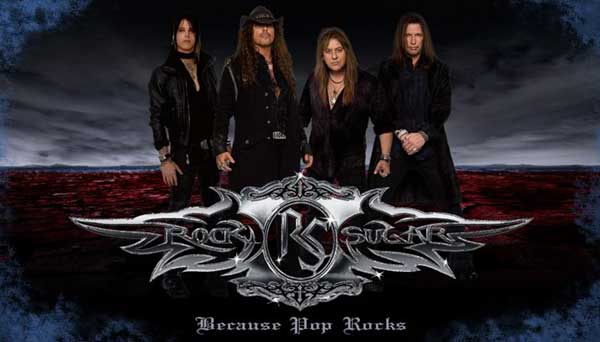 Today I would like to introduce you to the band Rock Sugar.
There are a lot of ways that music can combine with geek culture. Obviously, the work of Jonathon Colton and Kirby Krackle show this. Rock Sugar comes from a different angle.
The band’s connection to geek culture is not immediately obvious, but just listening to one of their songs gives one the sense of it.
The reason we care starts with the band’s lead singer, Jess Harnell. Jess is also a very successful voice actor, best known for being the voice of Wakko Warner from Animaniacs and Ironhide from the Transformer movies.
He is also an excellent singer, which should not be surprising to any Animaniacs fans.
But it’s not the fact that Jess is the band’s singer that makes them stand out. It is their hook.
Rock Sugar is a heavy metal band that does mashup songs of heavy metal and pop songs from the 80s.
I’m sure that last sentence didn’t make a lot of sense.
Basically, they will take two songs from the 80s, one metal, one pop; and arrange them into a single song with elements of both.
Mashups are nothing new. There is long history of taking two songs and mixing them together. Go on YouTube and you will find an endless stream of mashups, to the point that it has become a kind of art form all its own.
In the case of Rock Sugar, the difference is that they aren’t making a mix. They are writing a new song combining the two original songs and performing it themselves.
For example, one of their best known songs is called “Don’t stop the Sandman”, which combines Metallica’s “Enter Sandman” and Journey’s “Don’t stop Believin” – and yes, they make it work. You can see the video for it here.
A personal favorite of mine is “Shook me like a Prayer” which combines AC/DC’s “’You shook me all night long” and “Hell’s Bells” and Madonna’s “Like a Prayer”. Here is a video of Rock Sugar performing this song in concert.
As that last video shows, they are well-liked at music festivals, which is certainly helped by being excellent musicians.
Rock Sugar also have an active fan base, and they work to interact with them. Fans are encouraged to come up with new mashups for the band to make. This doesn’t mean it will necessarily happen, but they still want to include the feedback.
If you are interested in hearing more about Rock Sugar I would suggest going here and checking out their web site.
 I think it is story time again.
When I worked for Wizards of the Coast, part of my job was to travel to gaming conventions to promote the WotC game line. The company had sent me and a co-worker, one J.D., to a gaming convention in the mid-west (I have no idea what it was called anymore). Our job was to man the WotC both, demo games, and sell some product. Basically nothing out of the ordinary. What made this convention special was that the big guest of honor was my good friend Shawn . He was a game designer by this point, and therefore a big shot as far as the convention was concerned. Now let me take a moment to describe Shawn. He is a tall man, maybe 6’2”, broad in build and maybe a bit overweight at the time. He was dark haired and wore a goatee, and was without a doubt the hairiest man I had ever met.
Shawn was also the loudest man on earth as far as I was concerned. We had nicknamed him Captain Volume. Now I have a reputation for being loud, but I suspect that Shawn’s voice could kill small farm animals.
Let’s be clear, I like to think of my self as basically a nice guy. No, Really. But one thing that even nice guys do is prank their friends.
And Shawn had a weakness.
Not that long before the convention Shawn was on a date where he was made to watch a movie called Hopfrog. I have never seen this cinematic gem, but apparently it involves puppets and dwarves. Seeing it traumatized Shawn so much so that saying “Hopfrog” would always make him flinch.
At this point I think it is important to point out that the convention had a PA system, and a convention committee who liked a prank as much as anyone.
After a brief negotiation I arranged for someone to go over the PA and say “Hopfrog” every 10 to 15 minutes. It was a thing of beauty, because no matter where I was in relation to Shawn I could hear his mammoth voice cry out “Damn you Jeff Harris!”
This went on for 2 hours.
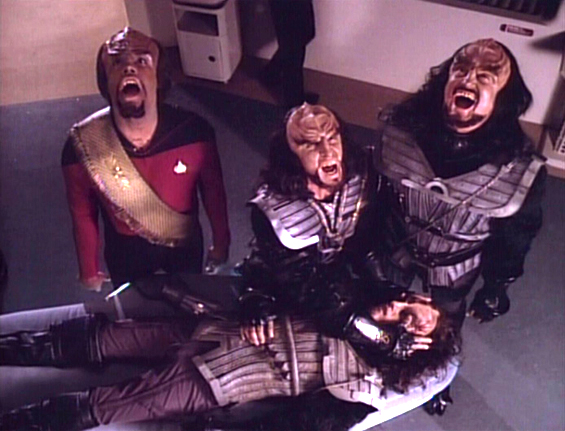
Did I mention that the convention had a Klingon jail?
What is a Klingon jail, I hear you ask? Well imagine if you will a charity drive where a bunch of Star Trek fans dressed as Klingons set up a “jail cell” at the convention. For a charitable donation they will go arrest someone and make them stay in the cell for one minute for every dollar you spend. Shawn, it seems, felt he had twenty dollars to spare for the worthy cause of revenge.
A very satisfied-looking Shawn and a very ragged-looking group of Klingons came to the table. I was arrested on the charge of impersonating a professional wrestler (Shawn was part of the infamous wrestling RPG group – Go back and check that story out if you need details)
“Hey guys, I’d love to play, but I have to work the booth.”
“No, I have it covered,” said J.D., damn him.
I had a great debate with myself. I knew that the cosplayers could not make me go off against my will, so I could always just say bugger off, and that would be the end of it. But on the other hand, there was the peer pressure to go along with the gag. And on top of that was the fact that I had been tormenting Shawn for 2 hours and he was due some payback. So off I went to the Klingon jail. They tried to cuff me, but I threatened to break the plastic cuffs if they did.
The “Jail” was about the size of a walk in closet. There were already 4 guys in there and only three chairs. There was no ventilation and so it was hot and smelled of sweat.
Now let me explain a few important facts. I don’t do well with heat. Or cramped spaces. Or sweaty guys I’ve never met. Add to this the fact that at the time I had just recently been diagnosed was diabetes and was probably having a blood sugar issue. The point here is that after just 5 minutes I was pretty pissed off.
I came to the realization (or perhaps rationalization) that I had only agreed to this with much coaxing, and that I saw no reason why I had to play in anyone else’s fantasy if I didn’t want to.
I got up to leave.
And the Klingon at the door went to stop me.
And here is where everything went horribly wrong.
The Klingon guard was a girl who I estimate may have been about 20, but possibly younger. She was maybe 5 feet tall. Rubber Klingon armor, rubber Klingon forehead, tin foil Klingon spear, and coke bottle thick glasses.
“Halt, you shall not pass.”
“Get out of my way little girl.” I said; well past the point of good manners.
She looked at me for a moment, and then burst into tears.
You see, here is what I think I missed at the time. In my very limited assessment, we have a very short young girl, thick glasses, probably not very popular at school, and doubtful that she felt empowered in her day to day life. Now I can see where dressing up as a Klingon warrior would give her a sense of power and importance that is missing from her day-to-day life. And here I am at 6’1”, not lacking in confidence, and frankly being very rude and condescending. I broke her illusion and made her cry.
And now everyone was staring at me. The Guards, the guys in the cell, passersby. And every stare said the same thing….
YOU ASSHOLE!!!
At the core I like to believe I am an empathic man. I do not like to hurt people. Yet here I have made this girl cry just because I had gotten cranky. So of course I turned around, went back into the cell, and sat in the corner until my sentence was up.
I’m not sure where the girl went. Some burly guy (well burly in the way Chris Farley was burly) took over the guard post. Eventually my sentence was up and I was released. As I left I could actually feel the stares following me.
I got something to drink and went back to the both.
JD was waiting for me.
“Dude, what’s this about you making a Klingon cry?”
“What?”
“Everyone’s talking about it. What did you do?”
“What do you mean everyone? It was just 15 minutes ago.”
“So you did make a Klingon cry.”
“I wasn’t trying to. I just wanted out of the cell.”
“Yeah, well I think you had better let me handle customer relations for the rest of the weekend.”
Shawn, of course, was not going to let this slip on by.
“So Mr. Harris, you made a Klingon cry. What’s next? Stealing candy from a Ferrengi?”
And years later after repeating this a few times a friend of mine who does a web comic adapted the story. And I am now played by a chain smoking Russian musician.
So what did I learn?
One, that there is no excuse for being an ass to anyone.
Two, that just because I don’t think something is a big deal doesn’t mean it isn’t to someone else.
And as for the practical joke war with Shawn, let’s just say I think I came out ahead there. Maybe someday I will share the tale of the Barney incident.
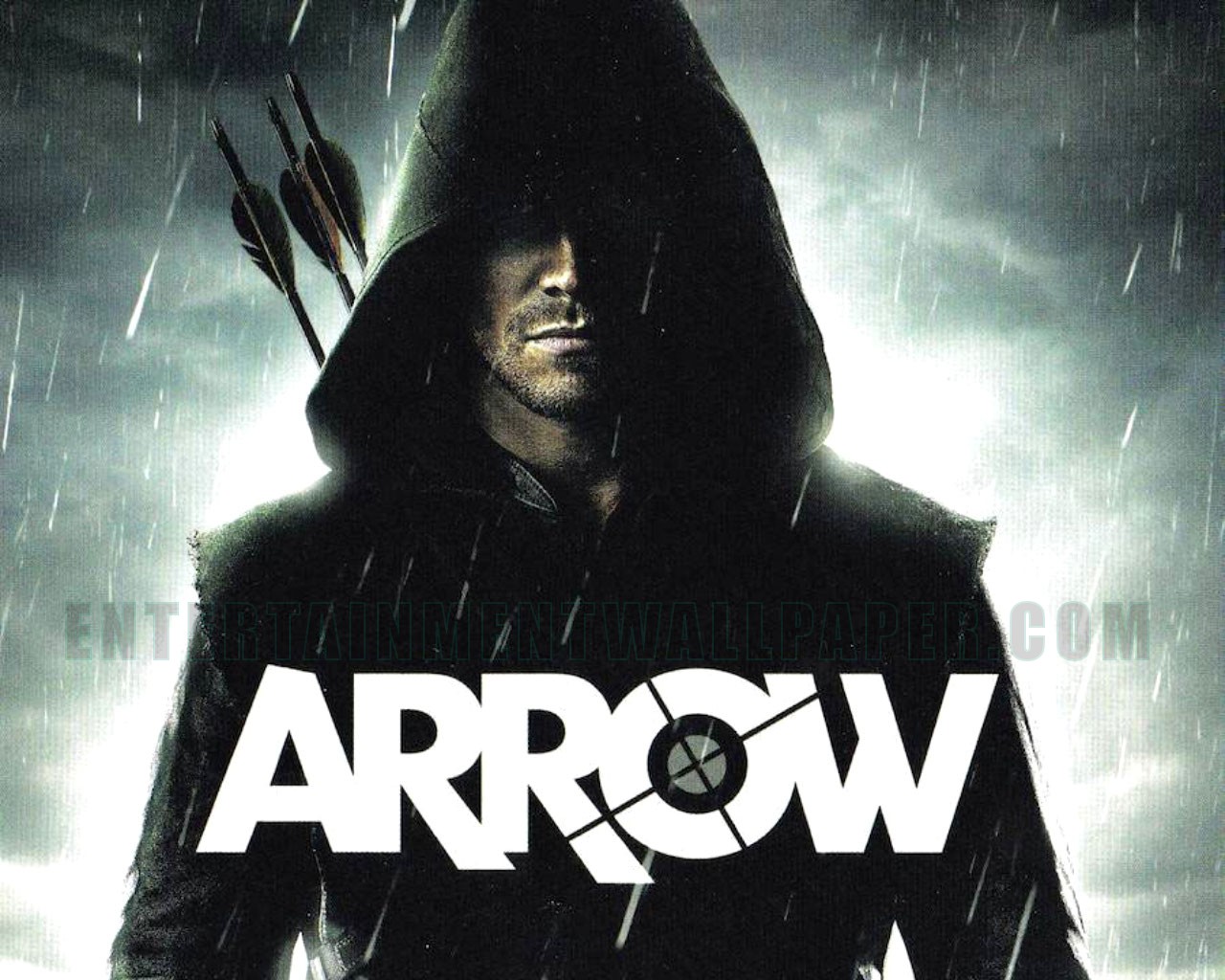 Back at the beginning of the season I did a review of Arrow, the CW’s take on DC Comics character Green Arrow. At the time of that review, the series had only aired five episodes. At the end of the review I promised to revisit the series at the end of the season. Well, the season has ended, so here we go. Go here to see what I said of if you haven’t already, as I am going to write this review with the assumption that you have read the previous one. I will not be avoiding spoilers either, so be warned.
First, let’s see if any of my opinions changed between then and now.
Back then I complained that Oliver Queen’s mother Moira, sister Thea, and best friend Tommy all suffered from underdevelopment compared to the rest of the characters. To varying degrees, all of them got better development as the season wore on.
Thea got the least. She is still Oliver’s troubled little sister, seeming to follow the pattern he set in his life pre-island of party girl excess. But after a drug bust and near imprisonment she had to do community service at the Laurel’s law office. This led her to meet a street tough named Roy Harper and start a relationship. It got her out of self-obsessed territory and made her more than just window dressing.
Moira got even more interesting. Her involvement with the villain of the story drove a lot of development, especially when it became clear that she was in over her head and just doing whatever she could to protect her family. This culminated in an attempt at redemption that was well played and should prove fodder for great drama next season.
Tommy ended up getting the best development in the series other than Oliver. While sharing the name of Oliver’s arch-enemy from the comics, it turned out that the Dark Archer was actually his father. This led to plenty of speculation as to which side Tommy would eventually end up on. His arc was well played. Once his father cut him off from the family money, Tommy honestly grew as a character. He found a job working for Oliver at his night club, and started an honest relationship with Laurel. One of the interesting points of that relationship is that every time Tommy was presented with a challenge that might have lead him back to his insincere party boy ways, he instead made the right choice. It created great tension in that he was good for Laurel, thus adding complications to Oliver’s relationship with both. This got even more intense when Tommy learned that Oliver was the Hood, leading him to abandon both Oliver and Laurel. This led to the biggest twist in the finale when Tommy risked, and lost, his life to save Laurel, and reconciled with Oliver as he died.
Since the last review there were five major characters introduced.
Roy Harper, played by Colton Haynes, I have mentioned before, as he is Thea’s boyfriend. He is significant to comic fans, as in the books Roy is the first Speedy, Green Arrow’s sidekick who ended up as the hero Arsenal. Roy’s arc is that the Hood saved him and now Roy wants to find him and learn from him. Basically Roy feels called to do better with his life, and feels working with the Hood is the way. It was not a big arc, but a good set-up for one next season, especially with his actions in the finale. Roy is going to be promoted to series regular next season.
Another character getting promoted to regular next season is Felicity Smoak, played by Emily Bett Rickards. Felicity is an odd addition, because in the comics she is a supporting character in Firestorm, not Green Arrow, but that is just a fanboy nitpick. At first I was annoyed by the fact that they had this obviously very attractive actress playing like she was an ugly duckling nerd. I had no problem with her being a nerd, but the way she acted was not matching how they had her look. Fortunately as the season progressed, she became more of a socially awkward and insecure character. She knew how she looked, but it was treated as another hindrance to what she loved to do. At first she was just someone that Oliver would come to when he needed some information that required computer skills. When he had to turn to her for help while wounded, she was not surprised, as she had deduced most of what was going on already. This makes her another example of not making smart characters act dumb for the sake of plot convenience.
Since then she has been part of Oliver’s team. However, she brings a problem I like to call the “Chloe syndrome,” named for the character Chloe Sullivan from Smallville. This is where the lead character has more on-screen chemistry with a secondary character than the official love interest. In this case, Felicity has a lot more on-screen chemistry with Oliver than Laurel does.
The third late addition is Tommy’s father Malcolm Merlyn, played by Torchwood star John Barrowman. As stated earlier he took over the role of the Green Arrow’s arch-enemy, the Dark Archer. It was good to see Barrowman break type and play a villain, especially one with some sympathetic aspects. Malcolm was a well-intentioned extremist. Sadly he will not be back next season.
The final newcomer is Slade Wilson, played by Manu Bennett. His character was teased from the first episode, as Slade in the comics is the villain Deathstroke, and we saw the Deathstroke mask in the first episode. His role is currently limited to flashbacks to Oliver’s time on the island. It was a good idea to bring on a new regular as part of the flashbacks if they are going to stay in use. It is also interesting to watch as Oliver and Slade are allies right now, but in the comic they are enemies.
Of the remaining cast, Paul Blackthorn is about the same as he was early in the season as Detective Lance. His arc was a minor one, with him eventually coming to realize that the Hood was needed to save the city, and that maybe they could be allies. It was a slow build that took all season, and for the most part it works.
The biggest disappointment is Katie Cassidy’s character Laurel, and in a lot of ways it isn’t her fault. While she did drive a certain amount of the plot, the writers put her in a bad spot. As a love interest for Tommy she worked great, showing his growth and making his final fate really hit home. As a love interest for Oliver she did not work as well. The two do have chemistry, but again it seems pale compared to the Oliver and Felicity. Add to that the fact that the writers have put just too many obstacles between them. But the worst part is that she just seems to be there as a motivation for Oliver, which is sad when you compare her to her comic book counterpart.
David Ramsey as John Diggle, Oliver’s partner in crime fighting, got a good arc in the latter part of the season, the discovery that reoccurring villain Deadshot killed his brother, and Diggle’s thirst for revenge, which created tension in the Diggle/Queen partnership. This plot thread has not been resolved, so there is more to mine from it. Outside of that they maintained the intelligence and skill that was shown early in the season and portrayed that Diggle is not just a sidekick.
And of course you have Stephen Amell as Oliver. Over the season, it is clear that he was a good find and perfect for the role of superhero. His athleticism has made his portrayal of Oliver all the more realistic. He also had two versions of the character at different times in his life, which has gone smoothly. The season finale showed him wounded and yet determined.

As regular readers know, I am a fan of web series as a format. The medium presents a huge potential of creativity and it is changing how we interact with media. One of the major factors fueling the web series’ advancement is its ability to monetize. This area is also where web series are feeling the most pain. Being able to make a profit on the content is vital if it is to continue to grow.
Put bluntly, the most efficient method of monetizing any online media content is advertising. Now I know that there are going to be people that say that paid subscriptions or buying clips is more profitable. This may be true in some circumstances, but these options also limit a series to only the people who have the income to pay. On the other hand, advertising costs the consumer nothing but time. But a lot of people out there find that even too high a price to pay.
Before we get into that, let’s go over some details. For a web series, advertising money usually comes in the form of a profit-sharing agreement with the video hosting site, although not every video host does this. For example, Youtube does have ad revenue sharing, but only with select partners; most people do not get this. On the other hand, Blip has ad revenue sharing with all their content creators. In an ad sharing deal, the norm is a 50/50 split of the profits, calculated on what is known as a CPM or Clicks per Mille formula, where mille equals 1000. A rate is set for every thousand views of an ad. If the CPM for an ad is $5.00, if you get 5,000 views, you make $25.00. Ad rates are not consistent, so profits can fluctuate even if views don’t. In this model, it is possible to be profitable and even make enough to make a living at it, but you need to have a high viewer rate. You also have to get your ads seen. The CPM is calculated on ad views, not video views. If the ad does not play, it is not added to the CPM calculation.
This is where programs like Ad Blocker enter the equation. There are a lot of reasons people will block ads. There could be an issue where certain types of ads cause the viewer’s system to crash. Some people claim they have gotten malware from ads. But most of the time, the reason people block ads is that they find them annoying.
Here is where we get into the thick of it. As the series producers only get paid for ads shown, when viewers use Ad Blocker, it cuts into the web series’ ability to produce a profit. This is a fact that has been debated back and forth, for as long as there have been web series and both sides have become pretty entrenched. Sites have tried to find ways to deal with this and recently, Blip launched a new salvo that has brought the issue forward again. Blip recently made a change to their site so that when they detect an ad blocker is being used this image comes up.

As stated, it makes the viewer wait 90 seconds for the video to start playing. This is hardly a new nor is it the most extreme tactic; other sites blocks that completely bar access to anyone who is using ad blocking software. Of course this raises hackles – several people equate it to bullying – and that community is already working on workarounds. But more importantly, this has brought to the fore the fact that Ad Blocker cuts into the producers profit. Many viewers in forums have stated that they were not aware of this fact.
Lewis Lovhaug (aka Linkara) produces the comic book review show Atop the Fourth Wall as part of the online review and comedy site That Guy with the Glasses. Linkara is one of the rare producers who is able to make a living by making a web series due to his large viewer base. He recently added to the advertising debate with a video wherein he explains how ad profits work and why Ad Blocker is a problem for producers like himself. He states that he does understand if people need to use Ad Blocker for legitimate technical reasons, but otherwise, if they don’t, to consider not using the software for his show, as it is how he makes his living.
This video set off a debate on the TGWTG forums. Several viewers were unaware of the impact Ad Blocker has on the producers and have set their Ad Blockers to allow advertising from Blip (a process called whitelisting.) Others took offense at the video, saying that they don’t owe Linkara anything, that it’s their right to use Ad Blocker and that it’s his tough luck.
So where does that leave us?
For me, it is a question of what we want to see happen. Web series have an amazing potential, especially as film-making and distributing technology improve and become more available to consumers. This could have a huge impact as people can make creative programing that no one in Hollywood would ever green-light. However, in order for that to happen, it has to be profitable. Otherwise, no one is going to be able to make it in any sustainable fashion, much less grow the medium.
I have read a lot of people saying that the current ad structure is not sustainable. I’m not sure I agree with that. I think that as long as there are ways around ads, big advertisers are going to be nervous about taking the plunge.
I have also read people telling Linkara and other producers to go and find sponsors to put in their videos directly. That idea looks good on paper but has several flaws. It would take time away from video production to find and negotiate with a sponsor. Furthermore, most deals stipulate the producer would only get paid during the life of a campaign. This means that if someone went into the series’ archive and watched an old video after the campaign ended, the sponsor of that episode would not be obligated to pay him again. With the current CPM ad structure, both new and old episodes have ads generating profit.
In the end, the question is: Do you want to see web series as a medium thrive or not? If the answer is yes, then I believe ads are the price we are going to have to pay. For myself, I find ads are a small price to pay for entertainment from a web series. If an ad comes on I don’t like, I just mute the computer. That way, I don’t have to hear it and the producer still makes money, allowing them to keep making more of what I like.
If another model does come about that works better I’m sure it will be adopted. Until then, we all have a choice to make.
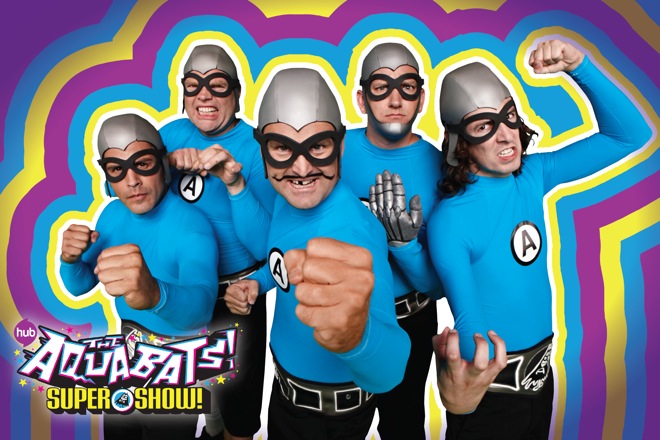 Imagine that some mad genius decided to cross the Adam West Batman series with the Monkees. That pretty much describes The Aquabats! Supershow! (And as much as my grammar checker hates it, those exclamation points are a required part of the title.)
Before looking at the show itself, we need to explore the Aquabats history.
The Aquabats are a band that formed in 1994 in Orange County. Originally an eight member ska band, they evolved due to band changes to a rock band with punk, new wave, and ska influences. What really makes the band stand out is their stage act. Their concept is that they are a team of superheroes who formed a band. Each band member adopts a superhero persona, and they wear matching superhero costumes. An Aquabats show will include bits where a supervillian will appear on stage for the team to banter with, and then fight, sometimes while they are playing a song. Musically they are influenced by Oingo Boingo and Devo.
The band has had ups and downs, and a couple of hiatuses, but they have a cult following and keep finding ways to keep on rocking.
At their height, the band had eight members. Currently that are at five. In total, 15 people have been members of the band at one time or another.
With their superhero theme and theatrical nature, a television spin off seems natural. However, it took three tries for them to make it happen.
The first attempt was in 1998, with a mini-pilot directed by Bobcat Goldthwait. Apparently it wasn’t very good, and even the Aquabats don’t want anyone to see it.
They tried again a year later with a music video for their album Vs. the Floating Eye of Death that also acted as a set up for a series plot. Fox Family Channel expressed interest, and were in the process of ordering a pilot when they were bought by Disney, and the project fell by the wayside.
While the band was on hiatus during 2004, band leader Glenn Jacobs became involved with television production. While the band was revving up again, one of his company’s pilots was picked up. The name of that show is Yo Gabba Gabba! You might have heard of it. With the success of that show, Jacobs was able to get some added exposure for the Aquabats by having them appear at times as musical guests. A new pilot was produced. Even then it took a few years to get the green light.
Eventually, Kids’ Network “The Hub” picked up the show.
The premise is not far from what I said at the beginning. The Aquabats are a team of superheroes who also work as a rock band. They travel around in their mobile command center/ tour bus, the Battletram. The show is campy, but not in the old Batman show style; feeling more like the Sid and Marty Kroft live action kids shows from the 70s.
The five current members of the band star in the show with each fleshing out his character more than in their stage show. All are presented as nice guys who want to help people, but have a bit of an underdog status.
The lineup consists of the following:
The MC Bat Commander (Glenn Jacobs): The team’s leader and lead singer. He is brave, but impulsive. He is also has complete confidence in everything he does, even when wading in without a plan. Although he is the only member who does not have superpowers, he is often the first to charge into battle.
Crash McLarson (Chad Larson): The team’s muscle and bass player. Crash is an endearing man-child, who has the power to grow to 50 feet tall. Unfortunately he cannot control this power, only growing when becoming emotional. And it’s not just anger, any strong emotion will do. Once the Bat Commander got him to grow by pointing out how sad the situation they were in was.
Eaglebones Falconhawk (Ian Fowler): The band’s guitarist. He is cockier than the rest of the team, and will at times strike out on his own. At first he had no powers, but uses a laser powered guitar as a weapon. After losing a battle with his archenemy and older brother Eagleclaw Falconhawk (Jon Heder), Eaglebones was visted by the spirit of the Sun (Lou Diamond Phillips), who gave him the power to summon a spirit animal (a female eagle named “The Dude”) and the power to see the unseen. After this, Eaglebones often acted as the voice of wisdom on the team.
Ricky Fitness (Richard Falomir): The band’s drummer. As his name implies, he is in the best shape of the team, and tries to get the team to be healthier, being the only one to not indulge in junk food. He is also portrayed as a lady’s man, often flirting with female characters, even villains. He also has a phobia about getting dirty. His power is superspeed.
Jimmy the Robot (James R Briggs Jr.): The band’s keyboardist. His name says it all – he is a very human-looking robot, with built in weapons, sensors, and detachable hands. He acts as the team’s scientist. He often feels lonely and worries that the team does not truly accept him because he is a robot.
Each episode has four elements. First is the live action story that runs throughout the episode, which features the Aquabats facing some enemy with the conflict being resolved by the end of the episode. At some point during the episode, someone will come across a TV screen in an odd location and exclaim, “Look, it’s a cartoon.” At this point a short Aquabats cartoon will be shown. Unlike the main plot, the cartoon has a serialized plot that runs through the course of the season. There will be a second very short cartoon featuring the Aquabats mascot Lil’ Bat. Finally each episode will have a parody commercial for a useless product from a company called Gloopy.
The guest stars are also often a treat. Besides Lou Diamond Phillips and Jon Heder, the show has included appearances by “Weird” Al Yankovic, and Samm Levine. Former Aquabats members Courtney Pollock and Boyd Terry appear as their superhero personas of Chainsaw and Catboy, but in non-Aquabat costumes. One very notable guest is Matt Chapman, who is one of series regular writers and directors. In one episode, he plays a ghost tormenting the team for disturbing his grave. More importantly he plays an evil carnival showman named Carl who looks and talks like Chapman’s character Strong Bad, from his site Homestar Runner. In the next season, the show will have appearances by Tony Hawk, as well as Mikey Way of “My Chemical Romance”. Mikey’s brother, Gerard Way, will direct this episode.
So overall how is the show?
Actually, it is really good. It knows what it is: a show aimed at kids, but with enough going on to entertain any adults willing to buy into its premise. The five leads are totally committed to their roles, and at no point seem embarrassed to be there. The guests also seem to enjoy themselves.
The production is naturally cheap, befitting the show’s budget, but this is the kind of show that turns that into an advantage. If you are able to get past the show’s cheesiness, it is very enjoyable.
Season 1 is currently available on Netflix. Season 2 will debut on The Hub on June 1st.
I give The Aquabats! Supershow! a grade of B+.
Click Here for episode 4
Now that they know what they are looking for ,Hermes and Hekate get some help from friends outside the family to point them in the right direction.
visit the shows main page here
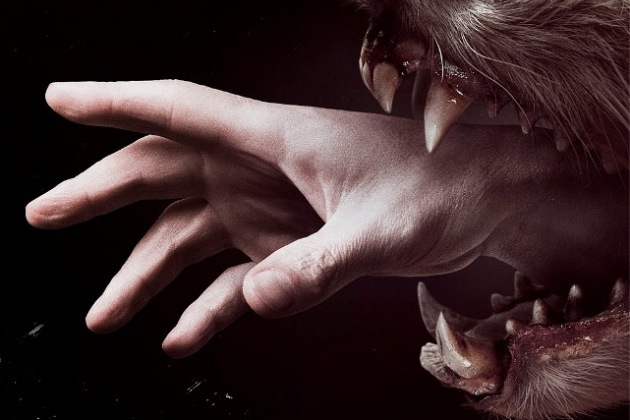 Hemlock Grove is the third series in Netflix’s push to begin presenting original programming to their subscribers. This is a significant move, as it is another piece in the puzzle that could significantly change how we consume media. Part of this plan includes putting the entire season up at once so that you can either watch the show over time or all at once.
But for this move to work the programming has to be good. Not all of it, though. Even the most successful networks have bad programming. But the better the programming, the more people are going to pay attention. The big push will be next month with the fourth season of Arrested Development.
But in the meantime we have Hemlock Grove, so how did they do?
Hemlock Grove is a supernatural mystery developed for television by Brian McGreevy and Lee Shipman based on a novel by McGreevy.
The show takes place in the eponymous town of Hemlock Grove, Pennsylvania. The main characters are Roman Godfrey, eldest child of the richest family in town, and Peter Rumancek, a gypsy who has just moved into town with his mother. The two meet when they are both drawn to the location of a violent death of a fellow student. They bond over being fatherless loners, and also over the fact that they both are supernatural in nature. Peter is a werewolf; and although he is not aware of it, Roman is an Upir, which even though the series acts like it is teasing it out, is clearly something akin to a vampire.
As the two bond, they decide to hunt down the student’s killer after a second attack occurs. The police think it is a wild animal, but Peter can tell it is a vargulf, which is the term for a werewolf that has gone insane.
Several of the other characters represent other horror story archetypes.
There is Christine, who fancies herself a novelist, and is familiar enough with folklore to recognize that Peter is a werewolf, although no one else really believes her, making her the exposition character which is more a universal archtype.
Shelly is Roman’s younger sister. She is nearly 7 feet tall, mute, bald (but always wearing a wig), and part of her face is deformed. She is also the sweetest most caring person in the story, and is used in the story to act as a gauge for the level of compassion in other characters. As her backstory is revealed it is clear that she is a Frankenstein archetype.
There is also Letha, Roman’s cousin, whom he is unusually close to. She becomes pregnant after an encounter with what she sees as an angel. Eventually she becomes Peter’s girlfriend. She is the damsel in distress archetype.
Roman’s mother Olivia is clearly a femme fatale and master manipulator. She is the evil temptress archetype.
Peter’s cousin Destiny has psychic abilities and in many ways both covers and subverts the witch archetype.
There is also a Battlestar Galactica reunion. Arron Douglas plays the town Sherriff, who is the typical horror movie lawman; and Kandyse McClure is Dr. Clementine Chausser, a Fish and Wildlife investigator and this story’s Van Helsing.
There are others but the show has a huge cast and I could be here all day covering them.
The story at its heart is a classic horror mystery. The heroes have to discover the identity of the monster and how to defeat it before it can kill again. But at times that is secondary to the exploration of the characters. The theme of the monster within is covered, both for the supernatural characters and the humans caught up in events, as they spin further out of control.
Bucking the current trend of supernatural storytelling, romance is not at the heart of the story, even poking fun at Twilight, as seems almost required these days. The core relationship is the friendship between Peter and Roman. In these days of prolific fanfiction, they are a duo almost tailor made for Slashfic. They are constantly drawn together by their need for friendship, while at the same time being pulled apart by their differing nature. Landon Liboiron as Peter and Bill Skarsgard as Roman give good performances, and are clearly the anchor of the series. The one downside here is that when Roman becomes emotional, Skarsgard’s natural Swedish accent starts leaking through which can be distracting.
Unfortunately the level of acting from the rest of the cast is uneven. Some are very good, like Dougray Scott as Roman’s uncle, and Lili Taylor as Peter’s mother. Others are fine but not anything that will stand out, such as Douglas and McClure, as well as Tiio Horn as Peter’s cousin Destiny. Some of the younger cast members definitely show their inexperience, especially Freya Tingley. She gives a very uneven performance as Christina – at times playing too wooden, and at other times over the top, but every once and a while doing fine. And then you have Famke Janssen as Olivia, where she is attempting to chew the scenery while going for a constant state of bored distance, coming off as a character from an Addams Family movie.
The show is best as a character study. As a mystery it does work as well, but I feel they telegraphed the identity of the vargulf a little too much. I figured it out three episodes prior to the reveal. This is not to say it is all bad. I was engaged with the story through to the end and did find myself caring about the characters.
From a production perspective it was clear that the show was working from limited budget, and found ways to work with it. The werewolf transformation, while not necessarily a new take, was done extremely well. There was also a reliance on suggested violence over outright gore, although there were gory aftermath scenes.
Overall I enjoyed the show and would certainly check out a second season if one is made. It is also a solid entry into Netflix original programming plan.
I give Hemlock Grove a C+.
When I was a kid, I got a copy of Orson Welles’s radio play adaptation of War of the Worlds. I had heard of it before and wanted to hear it myself. For those not aware, this was a 1938 Halloween production of H.G. Wells’ novel. Orson set it in the modern day, and the first half of the play was presented as a news report breaking into a radio show to tell the tale of an alien invasion. Due to the authenticity of the production, listeners who came in late thought that aliens really were invading New Jersey and people across the nation panicked. It was one of the best-documented cases of mass hysteria and crowd delusion ever.
Since then, there have been other shows that have used the live broadcast method to tell their story. Most go to great lengths to remind the audience that they are fiction. But even with this effort there will always be people that believe they are watching something real.
One of the most infamous of these was the BBC’s 1992 production Ghostwatch.
Ghostwatch was a 90 minute broadcast on Halloween, and was presented as a live investigation of a haunting. The producers’ intent was to create an experience much like the one Welles inadvertently created 54 years earlier. The show was listed in the Radio Times as a drama with a cast list, and there were credits at the beginning and end.
The story was that a team of ghost hunters and journalists were doing a live on-air investigation of a reported haunting in a London suburb. While the team on site was doing the investigation, back at the studio the evidence was being analyzed by a skeptical psychologist and the BBC host. A phone line had been set up so that the viewing audience could call in with their own theories.
Most of the first half hour was interviews with the family and backstory, with not much happening. The young girls in the house were terrified of a ghost they had named Pipes, due to the fact that their mother had explained strange noises as just being the pipes. As the investigation goes on, events start happening that unnerve the investigators, including an attack on one of the girls that requires her to be rushed to the hospital.
Eventually the investigation learns that the house was owned by a 19th century child murderer, and it is his ghost haunting the house. The attacks get worse, and one of the ghost experts realize that by broadcasting the investigation live they have created a massive séance that has supercharged Pipes. He proceeds to drag one of the Journalists, Sarah Greene, into a cubby hole, with the implication that he has killed her. Pipes escapes the house and appears at the BBC studio, with the suggestion that he can enter any home watching the show. He creates havoc in the studio and the final shot of the show has him possessing the host, Michael Parkinson.
While the BBC did take steps to promote the show as a drama, a huge portion of the viewing audience thought they were seeing a real event. Several factors played into this.
Due to a program overrun on another channel, a large percentage of the viewing audience tuned in late, thus not seeing the opening letting them know this was a drama, instead of a real event. The show also had a call-in number for people to use to share their own theories about the haunting. Once callers got through, they were reminded that the show was fictional, but encouraged to share any ghost stories they knew. As the show got more intense, more people called in, resulting in many callers getting a busy signal.
The way the show was shot was brilliant for the theme, and also added to the realism. They had an actor on set named Keith Ferrari who played Pipes. Ferrari was made up to be scarred and missing an eye. He would at times be in the background of a shot out of the camera’s focus range, or he would be standing in a corner when a quick pan occurred. Since the camera never focused on him, people who did notice him were sure they had seen the ghost.
But the main reason people believed it was real was that the cast included real BBC presenters playing themselves, including Michael Parkinson, Sarah Greene, Mike Smith, and Craig Charles. To give context for an American audience, this would be the equivalent of having Anderson Cooper, Matt Lauer, Ann Curry, and Al Roker star as themselves. And yes, this show was produced after Red Dwarf premiered, but Craig Charles’s career on British Television included being a frequent presenter, so his presence did not seem odd.
I suppose it goes without saying that there was a public outcry when the BBC, in response to viewer concerns, pointed out that the show was a drama. There were several complaints filed against the BBC, including one claiming that an 18 year old with severe learning disabilities had committed suicide after seeing the show. The complaint was dismissed, although the BBC did issue an apology. Due to the controversy, Ghostwatch has never been rebroadcast in the UK. It is available on DVD, however. Last month, a documentary¸ Ghostwatch: Behind the Curtains, was released in the UK on DVD, interviewing most of the participants in the original broadcast.
In spite of only being aired once, Ghostwatch is credited with being an inspiration for shows that blur the line between fact and fiction, such as The Blair Witch Project and modern ghost-hunting shows. The latter is due to the fact that even though it was a fictional program, Ghostwatch presented investigation techniques, such as night vision cameras and thermal imaging, that have become standard fair today.
So there you have Ghostwatch, a little-known gem that really does deserve a wider audience.